
What a Rolex Fluted Bezel Looks Like and What It Does
Posted by Luxury of Watches on 17th Nov 2026
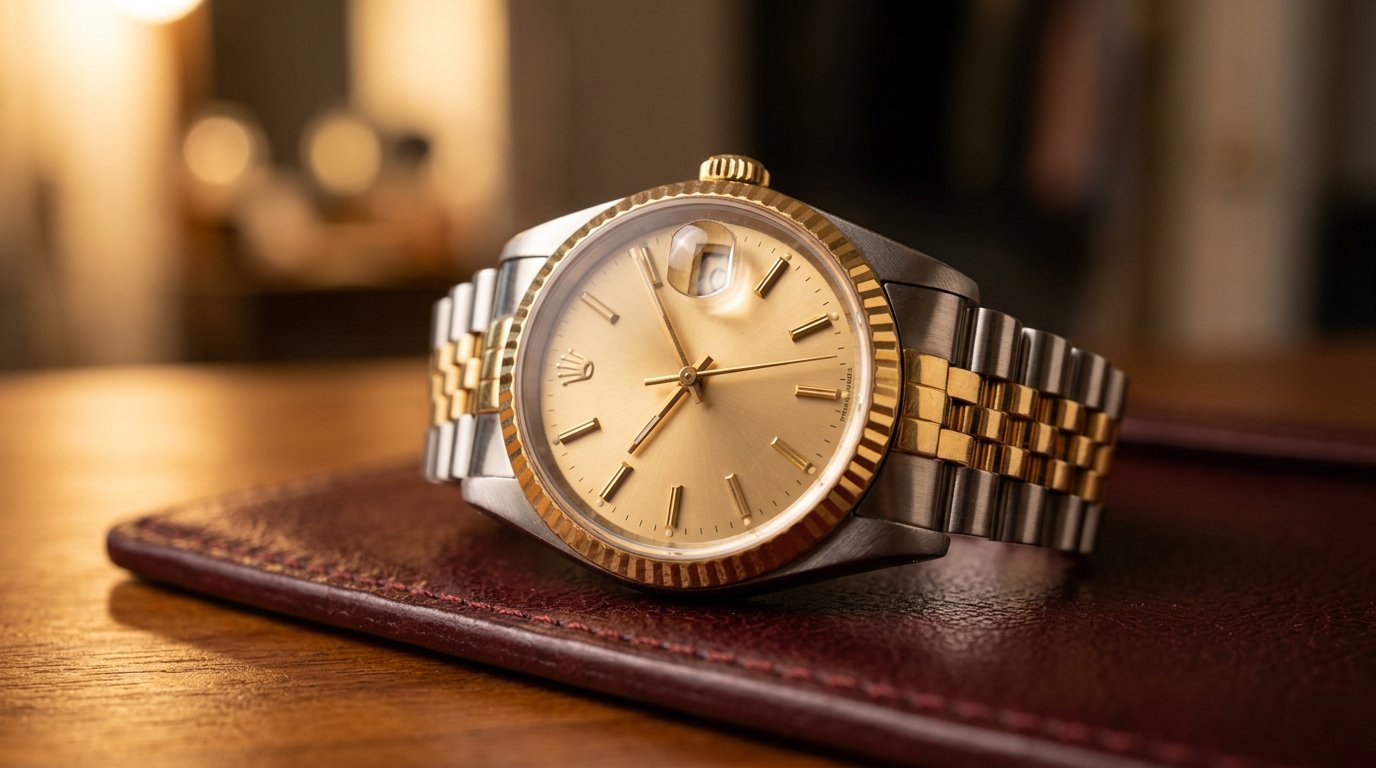
A Rolex bezel can be instantly recognizable before you notice the dial. A fluted bezel on a Rolex is the ridged, light-catching ring around the watch face, with a repeated pattern of narrow grooves. It frames the crystal and gives the watch a more defined, reflective profile.
A fluted bezel on a Rolex is more than decoration. The bezel surrounds the watch face, helping protect the crystal and support water resistance. Rolex originally used fluting to secure the bezel to the case; today, the ridges are also a distinctive design feature. If you’ve noticed them on a Datejust or Day-Date, this guide explains what the bezel does, how its flutes look, which Rolex models feature them, and the precious metals used to make them. You’ll also learn how a fluted bezel looks different from a smooth one, helping you understand this detail when considering a Rolex.
Key Takeaways
- Learn how bezel shape and surface pattern help distinguish fluted, smooth, and engine-turned designs at a glance.
- Recognize the Rolex model families where fluted bezels appear, and understand why the reference matters when identifying a specific watch.
- Find out which precious metals Rolex uses for fluted bezels and how material contributes to the watch’s appearance.
- Use the bezel’s profile, finish, and material as practical details to consider when exploring Rolex watches.
What are Watch Bezels and what purpose do they serve?
A bezel is the ring around a watch’s crystal and dial, defining the face while helping protect the crystal. On Rolex watches, its profile can also change the watch’s visual character, as the Datejust 41 references 126334 and 126300 illustrate.
Fluted, Smooth, and Engine-Turned Designs
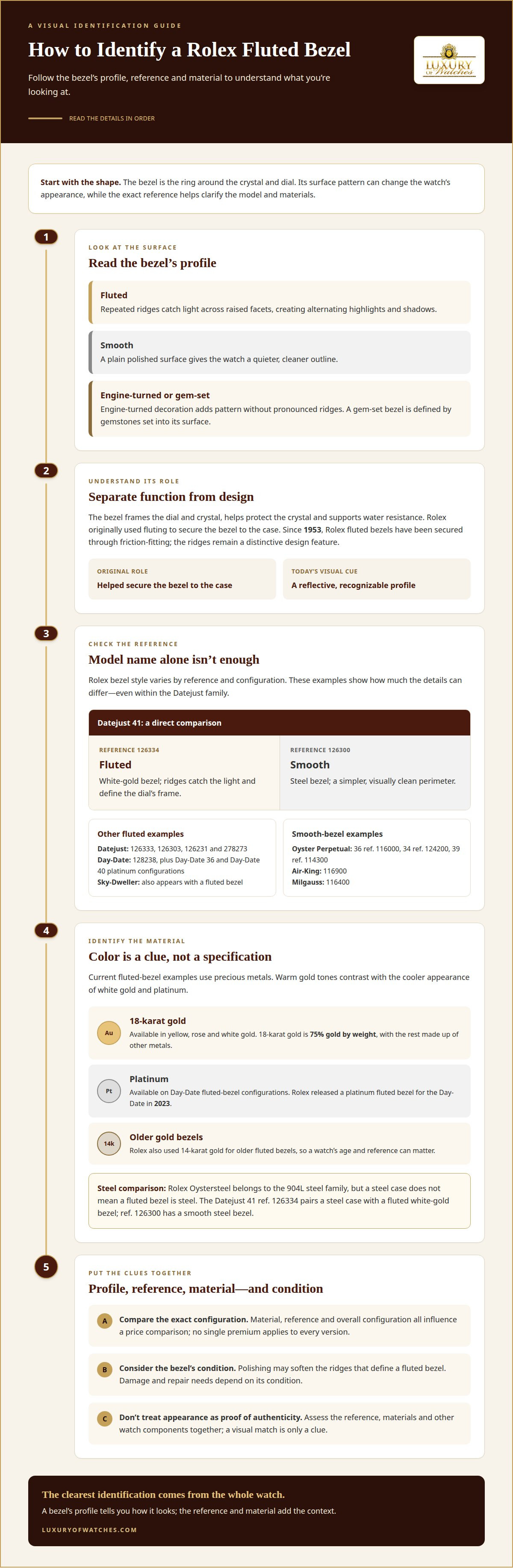
A fluted bezel has repeated ridges, a smooth bezel has a plain polished surface, and an engine-turned bezel carries a patterned finish. These differences matter when identifying a watch’s style: fluting creates alternating highlights and shadows, while a smooth surface offers a quieter outline. Engine-turned decoration adds texture without the pronounced ridges of a fluted design. Rolex originally used fluting to screw the bezel onto the case and help maintain water resistance; since 1953, its fluted bezels have been secured through friction-fitting.
Datejust Bezel Appearance
On the Datejust 41, reference 126334 has a fluted bezel, while reference 126300 has a smooth steel bezel. The first catches light across its ridges and gives the dial a more defined frame; the second keeps the perimeter visually clean. This contrast helps explain why bezel choice can make two Datejust versions feel distinct, even when their case proportions are similar. A fluted bezel can also be white gold, while the smooth version shown here is steel.
The bezel surrounds the dial and crystal, contributing to the watch’s structure and helping maintain water resistance. Its design also creates a distinct look: a fluted edge is more reflective and decorative, while a smooth edge is more understated. Rolex’s original functional use of fluting remains part of its design history, even though the ridges are now a recognizable feature.
A gem-set bezel differs from a fluted bezel: instead of repeated metal ridges, it has gemstones set into its surface. Fluting shapes the metal itself, while gem-setting makes the stones the bezel’s defining detail.
Bezel choice can affect a Datejust’s price, but no single premium applies to every version. Material, reference, and overall configuration all influence the comparison. The difference between a stainless steel smooth bezel and a white gold fluted bezel is not simply a matter of finish. Compare the exact model and materials, including on yellow gold configurations.
Rolex models with fluted bezels
Rolex uses fluted bezels across several model families, though the style depends on the specific reference and configuration. The Datejust, Day-Date, and Sky-Dweller are key examples. Oyster Perpetual and Air-King references, by contrast, illustrate Rolex’s smooth-bezel designs.
On the Datejust, references 126333 and 126303 are listed with fluted bezels. The Datejust 36 reference 126231 and Datejust 31 reference 278273 are additional examples. For the Day-Date, reference 128238 features fluting, and Day-Date 36 and Day-Date 40 references include platinum fluted-bezel configurations. Rolex released a platinum fluted bezel for the Day-Date in 2023. The Sky-Dweller also appears with a fluted bezel, giving this technical model a polished, recognizable signature.
Smooth bezels appear on other Rolex models and references, including the Oyster Perpetual 36 reference 116000, Oyster Perpetual 34 reference 124200, Oyster Perpetual 39 reference 114300, Air-King reference 116900, and Milgauss reference 116400. The Datejust 41 reference 126300 is another smooth-bezel example. These references show why the model name alone isn’t enough to identify the bezel: configuration matters.
Bezel design helps distinguish a Rolex’s appearance, but it doesn’t tell you everything about the watch. The model and reference provide more useful context: a fluted bezel may be a signature design feature, while a smooth bezel creates a simpler outline. Compare the exact reference and configuration rather than assuming every Datejust or Day-Date looks the same.
A Rolex fluted bezel can be polished, but polishing may soften the ridges that define its profile. Any damage and repair needs depend on the bezel’s condition. Its appearance alone cannot establish authenticity: the reference, materials, and other watch components must be assessed together. A visual match is a useful clue, not proof.
For a closer look at these variations, explore Rolex watches and compare their model references and bezel profiles.
Materials used for fluted bezels
Rolex fluted bezels are crafted from precious metals, rather than being simply ridged versions of every bezel material. Current examples include 18-karat white gold, yellow gold, rose gold, and platinum. The metal matters visually: gold tones create a warmer contrast around the crystal, while white gold and platinum offer a cooler appearance. On a Datejust 41, the fluting catches light across the bezel’s raised facets.
Gold purity helps explain the material label. An 18-karat gold bezel is 75 percent gold by weight, with the remaining composition made up of other metals. Rolex also used 14-karat gold for older fluted bezels, so the age and reference of a watch can matter when identifying its original bezel material. Yellow gold, rose gold, and white gold differ in color, but each gives the ridged surface a precious-metal finish.
Platinum is another option, including fluted-bezel configurations on Day-Date models. Rolex released a platinum fluted bezel for the Day-Date in 2023. This gives collectors a material distinction to consider alongside the model and reference, rather than treating every silver-toned bezel as steel. A polished platinum surface and a white-gold surface may look similar at a glance, but the material is a separate specification.
Stainless steel provides a useful comparison. Rolex Oystersteel belongs to the 904L steel family, and steel appears on Rolex watches, including smooth-bezel configurations. The distinction is important on an Oyster case: a steel case does not mean its fluted bezel is also steel. For example, the Datejust 41 reference 126334 has a fluted white-gold bezel, while reference 126300 has a smooth steel bezel. The crystal, case, and bezel are distinct components, so the exact reference helps clarify which material frames the dial.
Material also affects how a bezel looks beside a diamond-set dial or bracelet. Gold and platinum have their own tones and reflective qualities, while diamonds add a separate decorative element. Read the reference alongside the bezel specification for a clearer picture of the watch’s original configuration.
What a Rolex fluted bezel looks like
A Rolex fluted bezel is a ring of sharply defined ridges around the crystal. Each ridge forms a narrow facet, creating alternating light and shadow as the watch moves. This repeated geometry contrasts with the flatter dial and gives the case a more sculpted outline. The effect is decorative, but it also reflects the bezel’s original functional role in Rolex’s design history.
Look at the Datejust 41 reference 126334: its white-gold fluted bezel frames the dial with a bright, regularly spaced edge. As of 2025, Datejust and Day-Date fluted bezels have 72 flutes. The count helps describe the pattern, but the distinctive look comes from the rhythm of the ridges, not from counting them individually. Rolex describes the Datejust 41 reference 126334 bezel as “a mark of distinction.”
Fluting varies across Rolex models. As of 2025, the Sky-Dweller and Land-Dweller fluted bezels have 60 flutes, while the 1908 bezel has 180. Those differences create distinct patterns around each crystal. A smooth bezel, by contrast, presents an uninterrupted polished surface. Against a bracelet, the ridged edge adds another layer of texture; beside a smooth bezel, its reflections appear more pronounced.
The clearest visual comparison is between two Datejust references: 126334 has a fluted bezel, while 126300 has a smooth steel bezel. Check the bezel’s profile, then compare its material and reference with the case and bracelet. These details help you distinguish a genuine model configuration from a lookalike description, though appearance alone doesn’t establish authenticity. A fluted bezel is a luxury design feature, not a substitute for the watch’s full identifying details.
For a closer view of different Rolex profiles, explore Rolex bezel styles and compare the details that shape each watch’s appearance.
Luxury of Watches
Luxury of Watches helps you put bezel details in context while exploring luxury timepieces. Knowing how fluting, smooth finishes, and precious-metal choices differ can help narrow the style and model that suit your preferences. That perspective is useful whether you’re considering a Rolex, a used Rolex, or another pre-owned luxury watch. The collection also includes Breitling watches, offering another point of comparison as you consider design and presence on the wrist. A bezel is one part of a watch, so consider its profile alongside the dial, case, and bracelet rather than judging the model by one detail alone. If you’d like guidance as you explore these distinctions and available watches, contact Luxury of Watches.
Choose the Details That Feel Right
A watch’s appeal is personal. The bezel shapes its presence, but the right choice also depends on how the proportions, dial, and bracelet come together for you. Understanding what a fluted bezel on a Rolex looks like gives you a clearer starting point for deciding which details suit your taste.
Luxury of Watches offers Rolex watches, used Rolex watches, and pre-owned luxury watches for readers considering different options. As you narrow down your preferences, focus on the overall design and the specific reference, not just one detail. This makes it easier to choose a watch that feels considered and comfortable in your collection.
Ready to take the next step? Contact Luxury of Watches to discuss your interest in Rolex and pre-owned timepieces. Choose with confidence, guided by the details that matter to you.
Frequently Asked Questions
What is a Bezel?
A bezel is the part of a watch case that frames the dial and crystal. Depending on the watch, it may be fixed or designed to rotate for a specific purpose. On a Rolex, the bezel’s shape and material can also help identify a particular configuration. When comparing watches, treat the bezel as a distinct component, separate from the dial and bracelet.
What does a fluted bezel on a Rolex look like?
A Rolex fluted bezel has a repeated sequence of angular grooves around the dial, creating alternating bright and shaded facets. The effect changes as the watch moves under different lighting. For a concrete reference, Rolex describes the Datejust 41 reference 126334 bezel as “a mark of distinction.” A photograph viewed straight on may show the pattern differently from an angled view.
What is the purpose of a fluted Rolex bezel?
A fluted Rolex bezel began as a functional case detail, helping screw the bezel onto the case and maintain water resistance. The fastening method later changed, but the ridged design remained distinctive. This history explains why fluting is associated with Rolex, even when appearance is the main reason for choosing it. The bezel itself does not indicate the watch’s full water-resistance rating.
Which Rolex models have fluted bezels?
Fluted bezels appear on Rolex Datejust, Day-Date, and Sky-Dweller models, with the exact configuration depending on the reference. For instance, Datejust references 126231 and 126333 are listed with fluting, as is Day-Date reference 128238. If you’re identifying a particular watch, use its reference alongside the model name. A model family can include both fluted and smooth-bezel versions.
Are Rolex fluted bezels made of gold or steel?
Rolex fluted bezels are made from precious metals, including 18-karat white, yellow, and rose gold, as well as platinum. An 18-karat gold bezel contains 75 percent gold by weight. A stainless-steel Rolex case doesn’t necessarily mean its fluted bezel is steel: Datejust 41 reference 126334 pairs a steel case with a white-gold fluted bezel.
How is a fluted bezel different from a smooth or engine-turned bezel?
A fluted bezel has pronounced, repeated ridges; a smooth bezel has an uninterrupted surface; and an engine-turned bezel features an engraved pattern. Their different finishes create distinct reflections and textures around the dial. For a practical comparison, Datejust 41 reference 126334 has a fluted bezel, while reference 126300 has a smooth steel bezel. Check the reference to identify the specific configuration.