Tag heuer's brand repositioning explained
Posted by Luxury of Watches on 31st Oct 2026

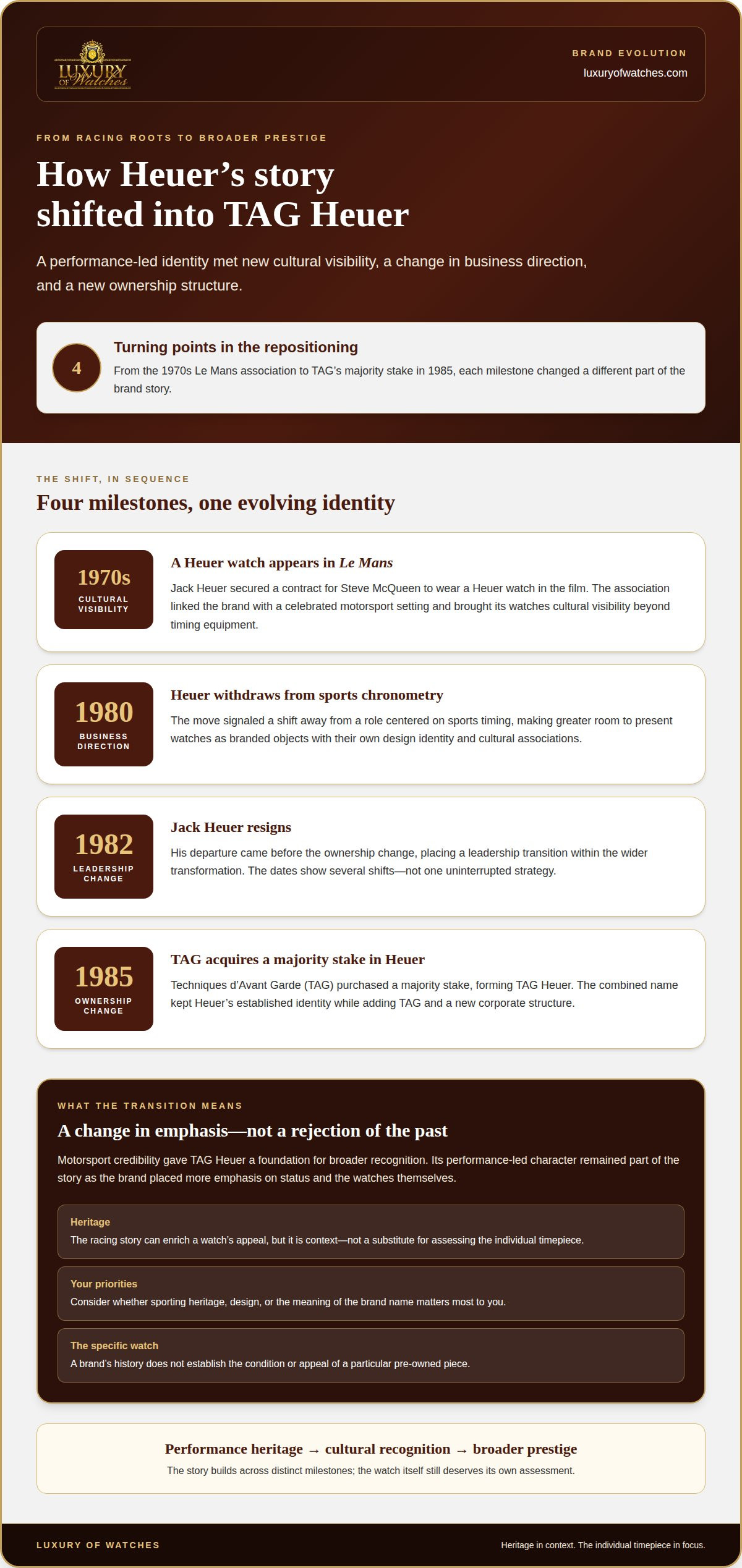
TAG Heuer’s racing heritage became a foundation for moving from accessible luxury toward greater prestige. Tag Heuer’s brand repositioning is best understood through that balance: a performance-led identity, iconic watches and a stronger emphasis on status. In 1985, Techniques d'Avant Garde (TAG) purchased a majority stake in Heuer, forming TAG Heuer, according to the Wikimedia Foundation.
TAG Heuer’s racing image is about more than speed and sporting function. Its watches have also earned cultural recognition, connecting technical heritage with desirability and prestige.
This article explains how that shift took shape and why it matters to how TAG Heuer is viewed today. It traces how motorsport roots and memorable watches supported the brand’s repositioning, and what that means when considering a TAG Heuer timepiece.
Key Takeaways
- See how motorsport credibility helped Heuer move beyond technical performance and build broader prestige.
- Learn how Jack Heuer’s arrangement for Steve McQueen to wear a Heuer watch in Le Mans strengthened the brand’s cultural visibility.
- Understand why leaving the sports chronometry business in 1980 marked a notable change in the brand’s direction.
- Use the distinction between heritage, positioning, and prestige to assess what draws you to a TAG Heuer watch.
The shift from accessible luxury to prestige
TAG Heuer’s move toward greater prestige built on its established performance identity. The aim was not simply to leave accessible luxury behind, but to give the brand’s history and watches broader status. To understand TAG Heuer’s brand repositioning, look at how sporting credibility became part of a wider brand story. For buyers, the distinction matters: heritage can shape a watch’s appeal, but it doesn’t replace assessing the individual timepiece.
Heuer’s racing connections helped create that foundation. In the 1970’s, Jack Heuer secured a contract for Steve McQueen to wear a Heuer watch in the film Le Mans. The association connected the brand with a celebrated motorsport setting and gave its watches cultural visibility beyond timing equipment. It also illustrates how a brand can use a recognizable person and film to make technical heritage meaningful to a wider audience—a storytelling principle that creative entrepreneurs, such as those supported by IAMFASHION, frequently draw upon when developing their brands online.
Ownership then changed the company’s identity. In 1985, Techniques d'Avant Garde (TAG) purchased a majority stake in Heuer, forming TAG Heuer, according to Wikimedia Foundation. The combined name retained Heuer while adding TAG, rather than replacing the established watchmaking identity outright. That decision created a link between the older name and a new corporate structure, giving the brand a basis for presenting its heritage in a broader luxury context.
The business direction had already begun to shift. TAG Heuer withdrew from the sports chronometry business in 1980. That step signaled a change in emphasis away from a role centered on sports timing. The distinction helps explain the repositioning: a company known for a technical function could place greater attention on watches as branded objects, with their own design identity and cultural associations.
Jack Heuer’s resignation in 1982 adds another turning point. His departure came before TAG’s majority stake in 1985, placing leadership change within the broader transition. These dates don’t establish a single, uninterrupted strategy. They show that the brand’s transformation involved changes in ownership and leadership as well as how its watches were presented to customers.
Racing heritage offered a strong asset, but also posed a challenge: a brand can draw attention through motorsport while still needing its watches to stand on their own. Buyers may value a timepiece’s story, but they also consider its design, identity, and fit with their preferences. This balance allows TAG Heuer to retain a performance-led character while seeking wider recognition as a luxury watchmaker.
Explaining TAG Heuer’s brand repositioning through heritage alone would leave out part of the picture. The brand’s history provides context, while the individual watch remains the object under consideration. For buyers, it helps to distinguish the appeal of the name from the qualities of a particular piece. Heritage may enrich ownership, but it does not establish the condition of a pre-owned watch.
The shift is best understood as a change in emphasis, not a rejection of the past. The Le Mans association, the 1980 business withdrawal, and the 1985 change of ownership each illustrate a different part of the transition. Together, these events help explain how a performance-focused identity could support greater prestige while remaining recognizable to customers familiar with Heuer.
To understand TAG Heuer’s brand repositioning in practical terms, consider what matters most to you: sporting heritage, design, or the meaning of the brand name. These priorities can guide your comparison, but keep them separate from an assessment of the specific watch. That way, you can appreciate the history without assuming every model has the same appeal or value.
Positioning heuer
Leadership offers a useful lens for understanding how TAG Heuer’s identity could be reframed. A change in executives doesn’t, by itself, define a new position. It can, however, bring fresh priorities to decisions about what a brand should emphasize. In TAG Heuer’s case, leadership transitions in 2014 coincided with attention to market performance and the brand’s place within a larger watch portfolio.
Jean-Claude Biver took over as CEO of LVMH’s Watch Division in 2014. That appointment placed him in a role overseeing the group’s watch business, including the strategic context surrounding TAG Heuer. His earlier experience included working with Oliver R. Müller at Omega in 1997. The connection provides professional context, but doesn’t prove that TAG Heuer copied Omega’s positioning or followed an identical playbook.
TAG Heuer also experienced senior leadership changes during 2014. Stéphane Linder was asked to leave the brand at the end of that year. Stéphane Babin had led TAG Heuer for 12 years before leaving for Bulgari in 2014. These events show why leadership matters to positioning: executives influence which parts of a brand’s identity receive emphasis, how it is presented, and how it competes within a portfolio.
Personnel changes alone don’t explain the brand’s direction. A leadership transition can prompt a reassessment of priorities, but positioning also depends on products, customer response, and execution. Explaining TAG Heuer’s brand repositioning through executive appointments alone would overlook these wider forces. Names and dates provide context, not a single cause or guaranteed outcome.
Market estimates provide another perspective. An assessment estimated TAG Heuer’s sales increased by 25% over the last 18 months. It estimated the watch market declined by 14% over that same period. Together, those figures suggest TAG Heuer performed more strongly than the wider market during that window. They don’t identify which products or business decisions drove the result, so they shouldn’t be treated as proof that repositioning alone caused the increase.
For readers, this distinction separates commercial momentum from brand prestige. Sales performance measures activity over a particular period; positioning concerns what customers associate with the name. The two can influence each other, but they are not interchangeable. Sales growth doesn’t make every watch more desirable, and a strong identity says nothing about the condition or appeal of a specific pre-owned piece.
When comparing watches, use the brand’s wider position as context, not as a substitute for evaluating the individual timepiece. Consider the design and identity that attract you, then assess the specific watch on its own merits. This keeps the decision grounded. TAG Heuer’s brand repositioning, viewed through leadership and market context, can inform your perspective without deciding which watch suits you.
Positioning is most useful when it clarifies a brand’s intended place in the market, not when it promises a particular result for every model. The 2014 leadership changes and the reported sales estimates offer context for interpreting that effort. If you’re weighing brand identity alongside a specific watch, explore the factors behind a watch’s appeal as part of your comparison.
Luxury of Watches: Rolex Watches
Luxury of Watches offers Rolex watches for readers comparing how different brands express prestige. If TAG Heuer’s racing identity appeals to you but you’re also considering a more classic luxury-watch profile, exploring Rolex can help you decide which brand’s history and design better suit your preferences.
Browse Rolex watches alongside pre-owned Rolex watches and other pre-owned luxury watches to compare established names and individual timepieces. The right choice depends on the watch itself, its condition, and the qualities you value most, not brand positioning alone.
Visit Luxury of Watches online to explore its Rolex watches.
Choose a Watch That Fits Your Priorities
Understanding TAG Heuer’s brand repositioning lets you consider its prestige story alongside the qualities that matter in your own watch search. Focus on the design, brand identity, and condition of the specific timepiece rather than relying on reputation alone. This keeps the decision personal and grounded in the watch itself.
If you’re comparing established names, Luxury of Watches offers Rolex watches, pre-owned Rolex watches, and pre-owned luxury watches. Explore these options to compare different expressions of luxury while keeping your preferences at the center of the choice.
For help exploring your options, contact Luxury of Watches. Take the next step at your own pace and choose a timepiece that feels right for you.