
How to Tell if Watch Diamonds Are Real by Their Setting
Posted by Luxury of Watches on 13th Nov 2026
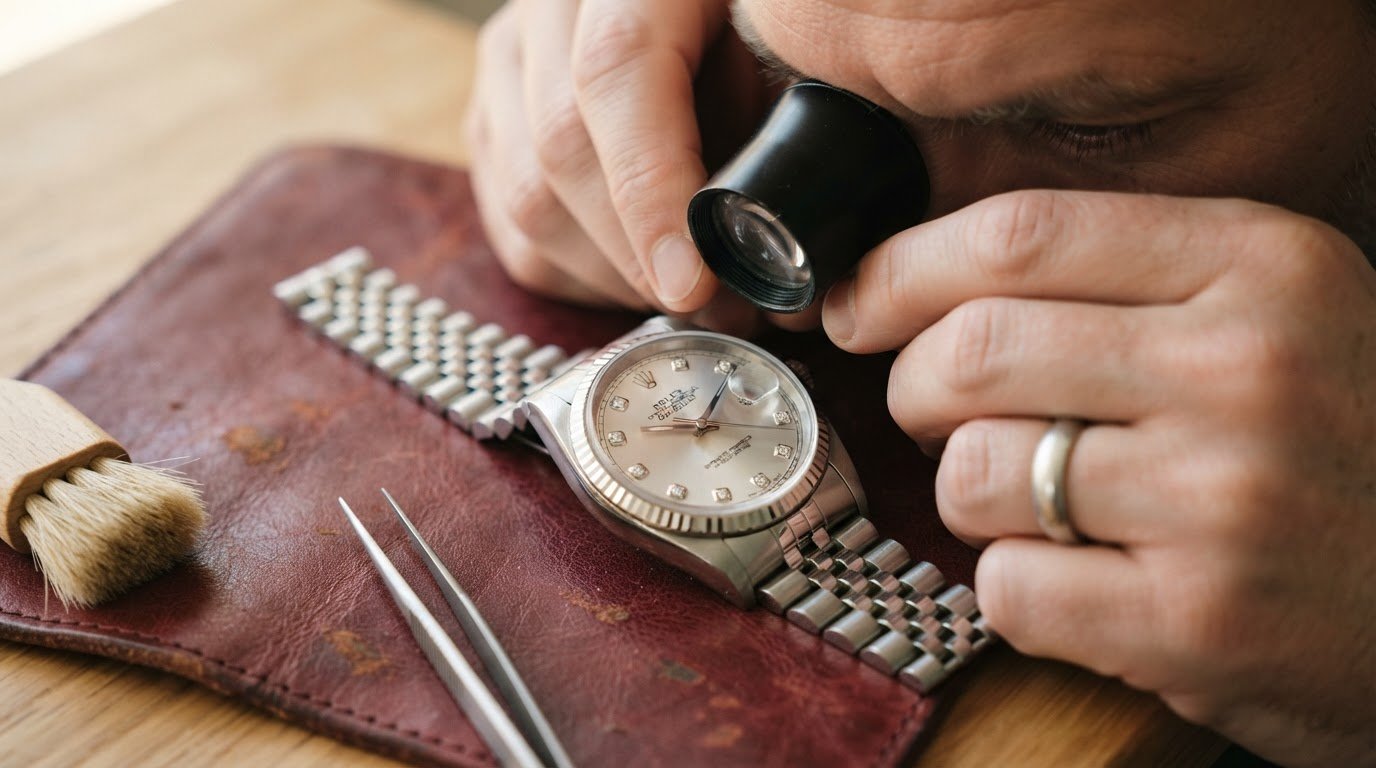
A convincing setting can make a stone look genuine, but it can’t prove the diamond is real. To tell if watch diamonds are real, look for careful, consistent craftsmanship and treat any metal hallmark as a clue, not a verdict. The most reliable confirmation comes from a professional assessment.
It’s natural to look for a quick answer in the way a stone is mounted or with a handheld tester. But a thermal diamond tester can read moissanite similarly to diamond, so that result alone can’t rule out every simulant. A synthetic diamond is still a real diamond, and identifying one requires laboratory testing.
This guide explains what a setting can reveal, how magnification and testers contribute to an assessment, and why documentation or a professional appraisal matters. You’ll learn to distinguish visible clues from reliable evidence before deciding about a diamond-set watch.
Key Takeaways
- Use the setting’s finish and metal hallmark as clues to craftsmanship, not proof of a stone’s identity.
- Magnification can reveal inclusions and facet details, though a flawless-looking stone isn’t automatically a simulant.
- Treat home tests as preliminary: some methods can damage a watch or stone, and no single result settles authenticity.
- Understand what a tester can and can’t distinguish, then use professional assessment and documentation for stronger evidence.
Assessing setting quality and craftsmanship
Treat the setting as a clue to craftsmanship, not proof of diamond identity. A jeweler’s charge for authenticating watch diamonds depends on the scope of the assessment, including whether it examines the mounted stone visually or uses specialized equipment.
-
Examine the jewelry mounting and setting
Examine each stone’s mounting under bright, even light. Look for consistent prong shapes, secure-looking edges, and spacing that suits the watch’s design. Compare stones around the dial or bezel: uneven alignment, noticeably different settings, or rough finishing may indicate inconsistent workmanship. These observations help assess the setting, but they can’t establish whether a stone is a diamond. Don’t press the prongs or try to move a stone, as this could disturb the mounting.
-
Check the setting metal and hallmark
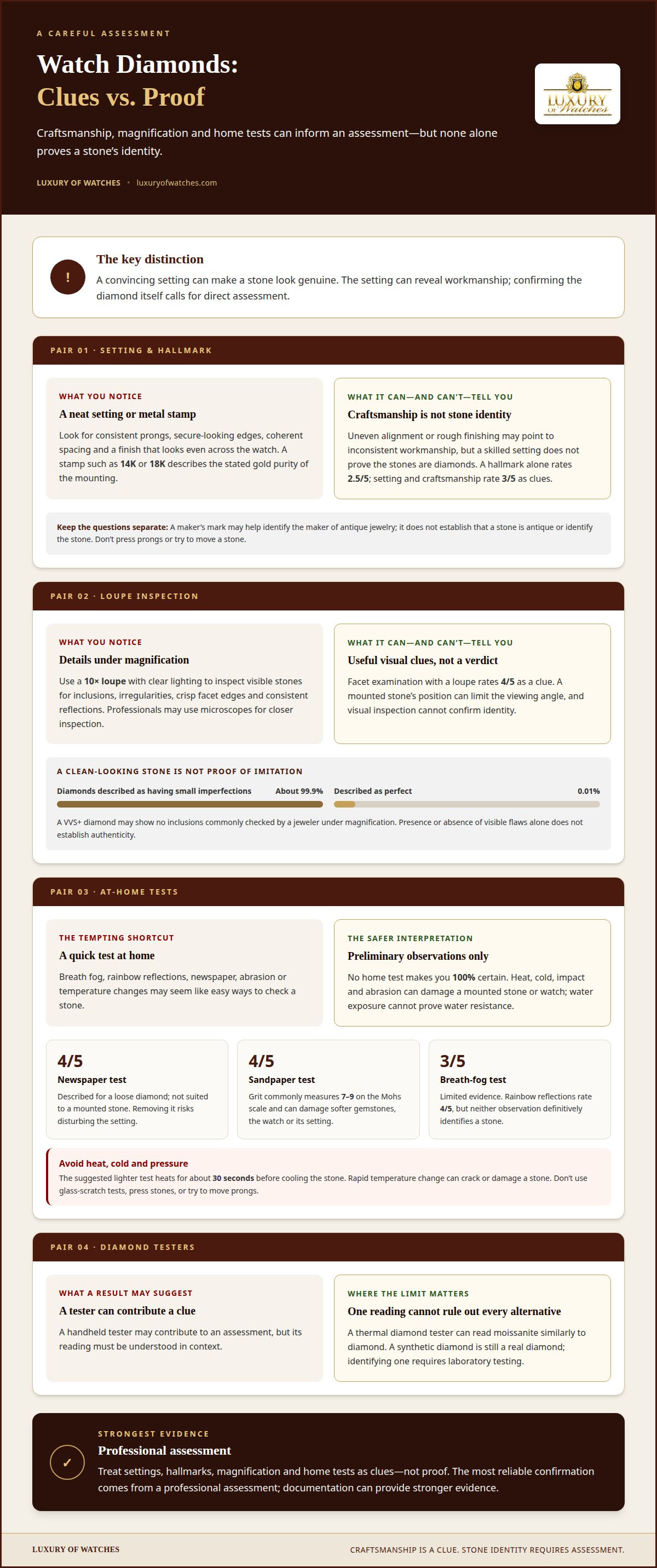
Look for a metal stamp on the setting, such as 14K or 18K. A hallmark can indicate the stated gold purity of the mounting, not the identity of its stones. For example, a setting marked 18K describes the metal; it doesn’t certify that any mounted stone is a diamond. A metal hallmark alone rates only 2.5/5 for accuracy as an authenticity clue, so treat it as one detail in the assessment.
- Assess the craftsmanship separately from the metal stamp. A neatly finished setting may reflect careful work, but skilled mounting doesn’t prove the stones are genuine. The setting and craftsmanship rate 3/5 for accuracy as clues. Check whether each stone sits consistently and whether the finish appears coherent across the watch. Use those observations to identify questions for a more direct examination of the gemstones.
- Consider maker’s marks when assessing an antique watch or jewelry setting. A maker’s stamp can help identify antique jewelry, but an old-looking setting alone doesn’t prove that its diamond is antique. Keep the questions separate: the mark concerns the maker, while identifying the stone requires examining the stone itself.
- Keep the cost question focused on the work requested. A visual examination of a mounted stone differs from an assessment using specialized equipment, and the setting can affect access. The scope of the assessment is therefore a key factor in the jeweler’s charge.
Checking diamonds for inclusions with a loupe
Magnification can reveal details the naked eye misses, but inclusions are clues, not a verdict. Examine stones carefully and interpret what you see in context.
-
Compare loupe and microscope inspections
Use a loupe with 10-times magnification to examine each visible stone. Hold the watch steady, use clear lighting, and scan the surface and interior for inclusions or irregularities. Jewelry professionals also use microscopes to inspect gemstones more closely. A loupe can help you notice details, but a mounted stone’s position and available viewing angle may limit what you can see. Don’t press the lens against the watch or attempt to remove a stone.
- Inspect facets as well as inclusions. Look for crisp facet edges and consistent reflections as you move the watch gently under the light. Facet examination with a loupe is rated 4/5 for accuracy as a clue. That rating describes a useful inspection method, not certainty about an individual stone. Record which stones appear different, rather than treating one visual feature as proof.
-
Separate inclusion clues from myths
Look for natural-looking inclusions, but don’t assume every genuine diamond must show visible flaws. About 99.9 percent of diamonds are described as having small imperfections, while 0.01% are described as perfect. A VVS+ graded diamond may show no inclusions that a jeweler commonly checks under magnification. A clean appearance alone therefore cannot establish that a stone is synthetic or imitation.
- Remember the limits of visual inspection. A loupe can reveal internal features, but it can’t confirm a stone’s identity. Distinguishing moissanite from diamond may require more than a casual visual comparison. If one stone looks unusually clear beside the others, treat the difference as a reason for closer assessment, not a conclusion. Inclusions can inform an evaluation, but their presence or absence alone doesn’t establish authenticity.
At-home testing reliability
Yes. Heat-and-cold, abrasive, and impact tests can damage a mounted stone or watch. A home test also can’t establish whether a watch remains water-resistant.
- Use visual checks only as preliminary clues. Home tests cannot make you 100% certain that a diamond is real. Rainbow reflections may offer an observation, but they don’t provide a definitive identification. Keep the watch intact and avoid applying pressure to its stones or setting.
- Skip the newspaper test on a watch. It’s described as a test for a loose diamond, with a 4/5 accuracy rating. A mounted stone can’t be placed over print in the same way, and removing it risks disturbing the setting. The result also isn’t professional confirmation.
- Avoid sandpaper, even though the test carries a 4/5 accuracy rating. Sandpaper grit commonly measures between 7 and 9 on the Mohs scale, and can damage gemstones softer than the grit. Abrasion also risks marking the watch or its setting. Don’t use it on a mounted stone.
- Don’t heat a watch with a lighter or put it into cold water. This suggested home test involves heating for about 30 seconds, then cooling the stone. Rapid temperature change can crack or damage a stone, while water exposure doesn’t prove the watch’s water resistance. A diamond’s ability to scratch glass also isn’t a safe test for a mounted watch.
- Treat a breath-fog result as limited evidence. The fog test is rated 3/5 for accuracy, while observing rainbow reflections is rated 4/5. UV light offers no decisive answer either: many genuine diamonds fluoresce blue, but an authentic diamond may not glow. These results can’t identify every simulant or synthetic diamond.
Diamond testers and certificates
Testers provide clues, while professional assessment and documentation put the results in context. Learning how to tell if watch diamonds are real means understanding what each method can and cannot establish.
- Separate a diamond’s identity from its origin. Lab-grown diamonds are real diamonds, just like mined diamonds, but an ordinary tester can’t establish where a diamond formed. Identifying synthetic diamonds requires laboratory testing. This distinction matters when a watch description or report refers to a stone’s origin.
-
Review diamond tester results and certificates
Use a tester reading as one piece of evidence, not a final verdict. A thermal tester can read moissanite similarly to diamond, so it cannot distinguish every simulant. Review available documentation alongside the result. A GIA diamond report assesses quality through the 4Cs: color, clarity, cut, and carat weight. Those details describe quality, while laboratory testing identifies synthetic origin.
-
Ask about testing diamonds in place
Ask whether the stones can be assessed while they remain mounted. A professional can use specialized equipment and expertise to examine watch diamonds without automatically removing them. Access depends on each stone’s position and mounting. Don’t try to remove a stone yourself, as this can disturb its setting. This step helps you determine how to tell if watch diamonds are real without unnecessary handling.
- Compare the report with the specific watch and stones it describes. A document about diamond quality doesn’t establish that every stone on a watch matches it. Note whether the report identifies the stone assessed and covers the relevant 4Cs. If the watch has several diamonds, clarify which stones the assessment examined.
- If you’re unsure about the authenticity of a seller’s diamonds, pause the purchase rather than relying on appearance or a single tester reading. Keep the seller’s description and any accompanying paperwork, then arrange a professional assessment with specialized equipment. A thermal reading alone can’t rule out moissanite, and lab-grown diamonds are real diamonds. Use documented findings to decide whether the watch matches its description.
Luxury of Watches
Luxury of Watches offers Rolex Watches, Used Rolex watches, Pre-Owned Luxury Watches, and Breitling Watches for readers considering a diamond-set timepiece. Once you’ve assessed the setting and understood the limits of visual tests, use that information to guide your buying decision. A polished mounting or single tester reading can’t replace documentation identifying the stones in a specific watch.
Explore the available timepieces when you’re ready to compare options, while keeping the distinction clear between choosing a watch and authenticating its diamonds. If a particular stone’s identity is central to your decision, rely on a professional assessment and relevant documentation rather than appearance alone.
For guidance on available luxury watches, contact Luxury of Watches.
Make your next watch decision with confidence
Let the evidence guide your next step. The setting can offer useful clues, but a purchase decision should rest on clear information about the specific watch and its stones. If their identity matters to your choice, pause and seek a professional assessment instead of relying on a home test. Knowing how to tell if watch diamonds are real helps you ask focused questions and weigh documentation alongside appearance.
Luxury of Watches offers Rolex Watches, Used Rolex watches, and Pre-Owned Luxury Watches for those considering a luxury timepiece. Keep your priorities in mind as you explore: the watch itself, its condition, and the information supporting your decision all matter. A considered purchase is more rewarding when the details are as compelling as the design.
For help exploring available timepieces, contact Luxury of Watches. Take your time, ask for clarity, and choose the watch that feels right for you.
Frequently Asked Questions
How can you tell real diamonds from simulants?
Look beyond appearance to distinguish a diamond from a simulant. A jeweler can combine close inspection with specialized testing, since a thermal tester may read moissanite similarly to diamond. Also distinguish diamond identity from origin: lab-grown stones are real diamonds, and laboratory testing is needed to identify them. A report can document quality, but it should correspond to the stone being assessed.
How do I examine the facets of a diamond?
View the stone under steady light and tilt it gently, watching how its facets reflect light. A round brilliant cut typically has 57 or 58 facets, while a single-cut diamond typically has 17 or 18. Different cuts have different facet patterns, so don’t treat a count alone as proof of authenticity. On a watch, avoid pressing on the setting while changing the viewing angle.
How do I search for imperfections in a diamond?
Use a clean loupe at 10-times magnification and look across the stone’s interior for small inclusions or irregular features. Inspect from more than one angle, since the setting can restrict your view. A diamond graded VVS+ may not show the inclusions commonly sought under magnification. So, a clear appearance doesn’t establish that a stone is imitation; record what you observe for a professional assessment.
How do I use a newspaper to test a diamond?
The newspaper test applies to a loose stone, not a diamond mounted in a watch. Place the loose stone over printed text and observe whether the lettering appears clearly through it; this visual method is not definitive. Its accuracy is rated 4/5, but that rating doesn’t make it conclusive. Don’t remove a watch diamond to try the test, since disturbing the setting can damage the mounting.
How can you visually tell if diamonds in a watch are real?
You can assess visible clues, but sight alone can’t confirm a watch diamond’s identity. Compare the stones’ appearance and alignment, then examine their facets in clear light. A hallmark describes the setting’s metal, not the stones. Differences between stones can guide further examination, but a polished appearance or precise mounting doesn’t establish authenticity. Use visual observations to focus a professional assessment on specific stones.
How to use a diamond tester on watch diamonds
Treat a diamond tester reading as one clue, not a final verdict. A thermal tester can read moissanite similarly to diamond, so ask a professional to assess the mounted stones with specialized equipment and review any documentation.