
5 Iconic Chronograph Watches and the Stories Behind Them
Posted by Luxury of Watches on 29th Oct 2026
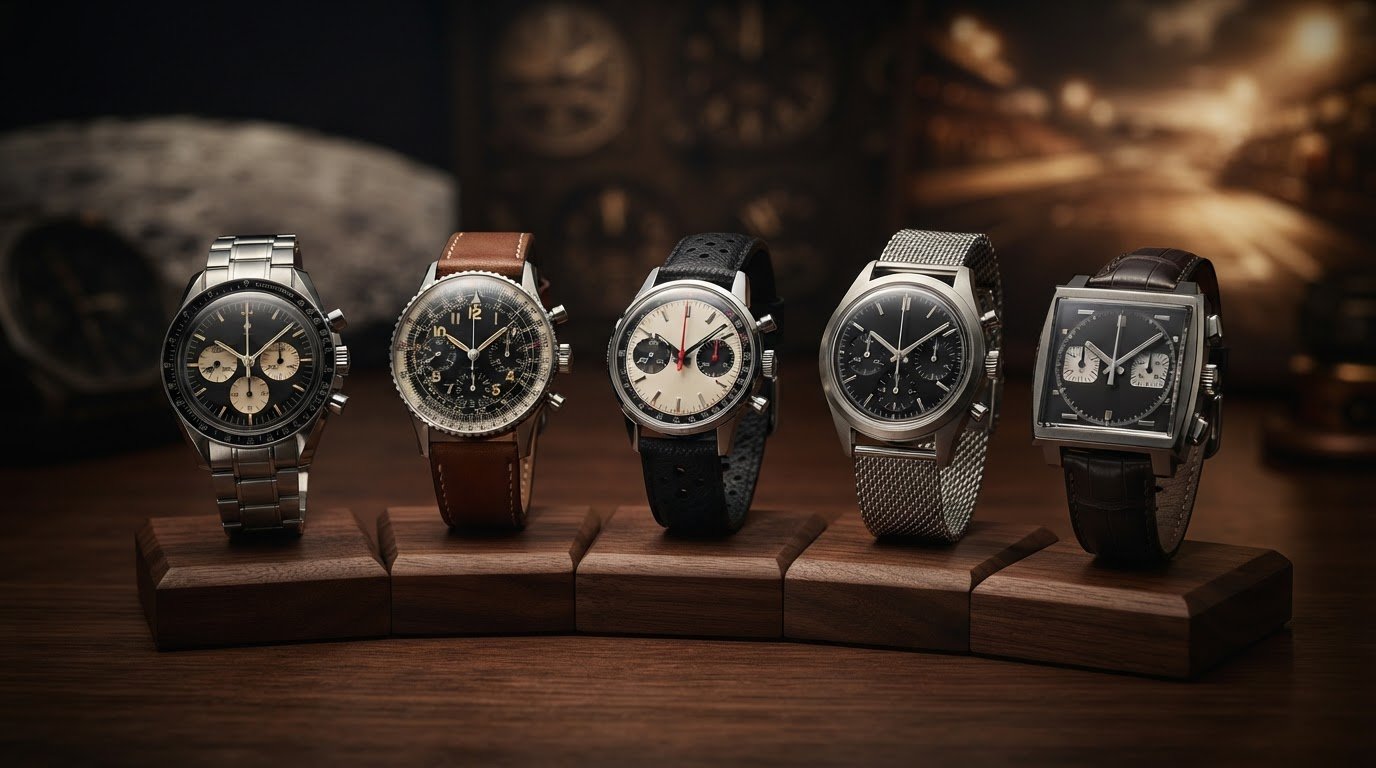
The top 5 iconic chronograph watches tell distinct stories: the Omega Speedmaster is tied to spaceflight, the Breitling Navitimer to aviation, and the Rolex Daytona to motor racing and a record-setting auction. The TAG Heuer Carrera and Heuer Monaco complete a shortlist shaped by legibility, design and enduring cultural appeal. Together, they show why a chronograph can be both a precise timing instrument and a lasting piece of watch history.
Choosing among these names can feel like choosing between milestones: a watch worn on the moon, a pilot’s tool with a slide rule, or a racing chronograph linked to an extraordinary sale. This guide explains what sets each apart and the history behind its reputation. You’ll also find notable chronograph selections to help connect the stories with the features and styles that matter when considering a watch for yourself.
Key Takeaways
- Trace the Speedmaster’s path from NASA’s search for an astronaut timepiece to its place in Apollo 11 history.
- Learn how the Navitimer’s circular slide rule reflects aviation’s need for calculations at a glance.
- See why Paul Newman’s Daytona became a landmark collectible, and what its auction story reveals about watch provenance.
- Compare standout chronographs by the design, heritage and purpose that make each one distinctive.
1. Omega Speedmaster and spaceflight history
Omega’s Speedmaster has been on the market since 1957, giving its spaceflight story a longer arc than its later lunar association. NASA began searching for a standard-issue astronaut timepiece in 1962. The Speedmaster became the defining master chronograph of that story, with a sports-watch character distinct from aviation-led designs such as Breitling’s Navitimer.
NASA’s testing and qualification marked a decisive step in the watch’s history. The agency evaluated wristwatches for astronaut use, and in 1965 declared the Omega Speedmaster flight qualified. That milestone established its suitability for NASA spaceflight, not merely its appeal as a mechanical chronograph. The qualification gives collectors a clear historical reference point: the model moved from commercial watch to approved flight equipment through NASA’s assessment.
The association reached its most memorable moment during Apollo 11 in 1969. Buzz Aldrin wore an Omega Speedmaster on the lunar surface, connecting the watch to one of the most recognized missions in spaceflight history. That event explains why the Speedmaster Professional is widely known as the “Moonwatch.” A later version of the Speedmaster Professional Moonwatch has a 42mm case, while the model’s broader identity rests on its NASA connection and readable chronograph layout. Its story differs from the racing heritage of TAG Heuer and the high-frequency movement history of the El Primero.
The TAG Heuer Carrera chronograph was introduced in 1963 and became associated with motorsport timing and a clean, legible dial design. The Carrera Chronograph Glassbox has a 39mm case, while the Carrera Heuer 02 version has a 42mm case and an 80-hour power reserve. Those specifications offer practical reference points when comparing chronographs.
For readers weighing the top five iconic chronograph watches, the Speedmaster stands apart through a documented sequence: market introduction, NASA search, flight qualification, and Apollo 11. That progression gives the watch meaning beyond its functions, while the Carrera shows how another chronograph’s identity can grow from a different arena.
2. Breitling Navitimer and its aviation slide rule
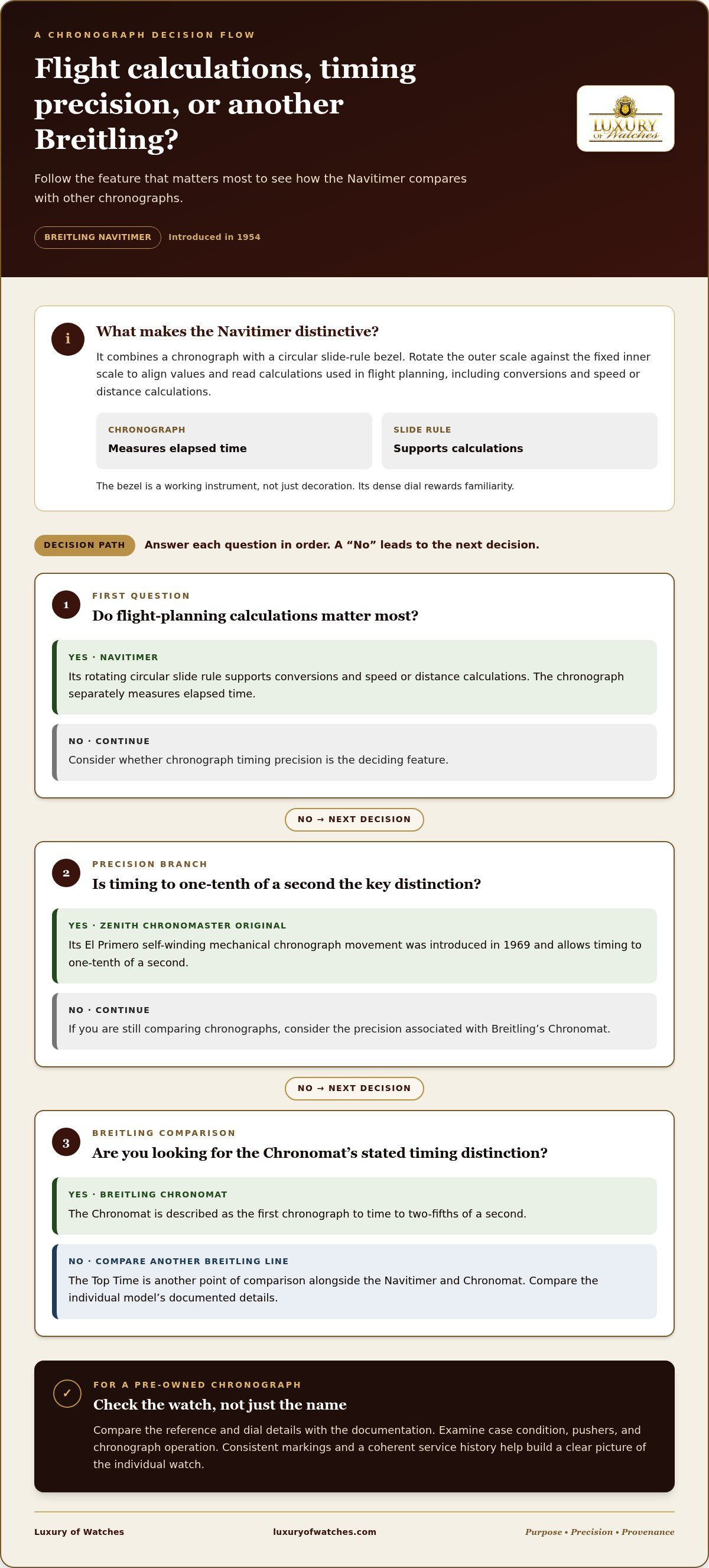
Breitling introduced the Navitimer in 1954, combining a chronograph with a circular slide-rule bezel. The rotating scale lets a wearer perform calculations used in flight planning, including conversions and speed or distance calculations. Instead of relying on a separate instrument, a pilot could align the bezel’s scales and read the result from the dial. This distinctive feature gives the Navitimer its unmistakable, instrument-led appearance.
The bezel is central to the Navitimer’s aviation functionality, not merely decoration. A pilot rotates the outer scale against the fixed inner scale, then reads the aligned values. The chronograph measures elapsed time, while the slide rule supports calculations. Together, these functions explain the Navitimer’s reputation as a pilot’s chronograph and why its dense dial rewards familiarity.
Breitling’s chronograph history also includes the Chronomat, described as the first chronograph to time to two-fifths of a second. That precision reflects another side of the brand: refining timing functions while building specialist instruments. The Top Time offers a further point of comparison. Its place alongside the Navitimer and Chronomat shows how Breitling’s chronographs extend beyond aviation-focused designs.
Zenith’s Chronomaster Original stands apart through the El Primero, a self-winding mechanical chronograph movement introduced in 1969. It allows chronograph timing to one-tenth of a second, a defining technical distinction from the Navitimer’s slide-rule functionality.
For a pre-owned chronograph, compare the reference and dial details with the watch’s documentation, then examine case condition, pushers, and chronograph operation. Consistent markings and a coherent service history help build a clear picture of the individual watch. These checks matter across brands, whether considering a Breitling or another maker. To explore available examples, browse this pre-owned chronograph selection and compare each watch’s documented details.
3. Paul Newman’s Rolex Daytona and auction record
The Rolex Daytona’s identity brings together motorsport associations, an evolving design, and a remarkable collecting story. Early references 6239 and 6263 became associated with Paul Newman, whose name now helps distinguish certain Daytona dial designs. That connection gave the watch a cultural profile beyond its chronograph complication, joining horology with the public image of a celebrated actor and racing enthusiast.
Popularity did not rise in a straight line. The Daytona received a major makeover in the 1980s, a change that helped turn around its popularity. The shift shows how a model’s reputation can evolve as design and public attention change. Its motorsport character remained central, while later generations brought new movement development and renewed interest from collectors.
That record-setting result made the watch’s provenance inseparable from its appeal. The sale was not simply about the Daytona name: the specific watch’s connection to Newman gave its ownership history exceptional significance. For collectors, this illustrates how documented provenance can shape the meaning of an individual watch.
The Rolex Cosmograph Daytona also stands out through its mechanical evolution. Early models used the Valjoux 72 movement. The second generation launched in 1988, followed in 2000 by a third generation powered by Rolex’s in-house calibre 4130. That sequence gives buyers clear reference points when comparing versions, movement architecture, and production eras.
These milestones explain why the Daytona is considered one of the most iconic chronographs: its racing identity, changing popularity, and connection to Paul Newman give it a history few watches can match. When assessing a Daytona, compare its reference, dial, case condition, movement, and available documentation. Collectors also consider how the winding mechanism operates and whether the watch’s details align with its stated era. Across luxury brands, those specifics help distinguish an individual watch from the larger legend.
4. Iconic chronograph watch selections
The top five iconic chronograph watches are the Omega Speedmaster, Breitling Navitimer, Rolex Cosmograph Daytona, TAG Heuer Carrera, and TAG Heuer Monaco. Each stands out for a different reason: spaceflight heritage, an aviation slide rule, racing associations, or a recognizable case and dial design. The right choice depends on the history and practical features that matter most to you.
These model families have contemporary versions, while historic references are generally encountered as pre-owned watches. For example, the Speedmaster Professional and Cosmograph Daytona have current versions, while Paul Newman-associated Daytona references 6239 and 6263 represent specific early examples. The Carrera, introduced in 1963, and the Monaco, released in 1969, also have modern counterparts. Availability therefore depends on whether you want a current-production design or a particular vintage reference.
Prices in the US vary by model, reference, material, condition, and whether a watch is new or pre-owned. A specific historical reference may be valued differently from a contemporary version in the same family. Compare the movement, case condition, documentation, and provenance alongside the asking price. These details help explain differences between individual watches without treating every chronograph as equivalent.
For a focused comparison, start with the feature that matters most. The Navitimer’s bezel supports calculations, while a chronograph records elapsed time. The Carrera and Monaco offer TAG Heuer interpretations shaped by motorsport, while Zenith’s El Primero is known for timing to one-tenth of a second. Automatic movements offer another point of comparison for collectors weighing mechanical design against heritage.
Use this shortlist to narrow your priorities: choose the story, design, and movement that suit your preferences, then compare individual references and condition. Explore available luxury chronograph watches to compare models across established watchmakers.
Luxury of Watches: Rolex Watches
Luxury of Watches is a natural next step if the Rolex Daytona’s racing heritage has you considering a Rolex chronograph. Explore Rolex Watches and Used Rolex watches alongside Pre-Owned Luxury Watches, or compare Breitling Watches if aviation history is more compelling. Reviewing these options by reference, design, and provenance can help you focus on the chronograph that best suits your collecting interests. A pre-owned Rolex may appeal if you’re drawn to an earlier design; a broader luxury selection can help you compare watchmaking traditions across brands. For a closer look at the available selection or help with your next step, contact Luxury of Watches or visit luxuryofwatches.com.
Choose the Chronograph That Fits Your Story
The right chronograph is more than a celebrated name. It should suit your daily routine, reflect the design details you value, and have a history you’ll enjoy revisiting. Use the top five iconic chronograph watches as a starting point, then narrow your choice by considering the proportions, dial layout, and mechanical character you prefer. A watch you connect with personally can be more rewarding than one chosen for reputation alone.
If you’re ready to move from research to browsing, explore Rolex Watches, Used Rolex watches, and Pre-Owned Luxury Watches through Luxury of Watches. Comparing individual pieces lets you focus on the watch itself and the details that make it distinctive. Explore chronographs at Luxury of Watches and take the next step toward a timepiece that feels right for you.
Frequently Asked Questions
What Are the Best Chronograph Watches?
The best-known choices include the Omega Speedmaster, Breitling Navitimer, Rolex Cosmograph Daytona, TAG Heuer Carrera, and TAG Heuer Monaco. The right fit depends on what you value: a highly legible dial, a distinctive case, aviation calculations, or a racing connection. Compare the specific reference, movement type, size, and condition rather than relying on reputation alone. This makes a shortlist more useful for choosing a watch.
Which Chronographs Hold Their Value?
No model’s future resale value is assured, and a famous name alone doesn’t determine it. Collectors weigh the exact reference, originality, condition, provenance, and completeness of documentation. A rare configuration or notable ownership history can distinguish one watch, while heavy wear or altered components can affect its appeal. Before choosing a chronograph as a collectible, decide whether historical significance, daily wear, or future resale matters most to you.
What makes the Omega Speedmaster Professional an iconic chronograph?
The Speedmaster Professional’s identity combines functional chronograph design with its association with human spaceflight. Its appeal also lies in how clearly the dial presents elapsed-time information. Consider how you’ll use the chronograph, whether the case proportions feel comfortable, and which version’s details suit your taste. These practical considerations connect the model’s history with your reasons for wearing it.
Why is the Breitling Navitimer an iconic chronograph watch?
The Navitimer stands out because its circular slide-rule bezel adds a calculation tool to the chronograph. This combination creates a dense, technical dial rooted in aviation. When evaluating one, consider whether you value its instrument-like functionality and feel comfortable reading the scales. The bezel’s visual complexity is part of the appeal, but legibility and personal preference matter when comparing watches.
How do these chronographs compare in movement, accuracy, case size, and water resistance?
They differ by reference, so compare the exact model rather than assuming one specification applies to an entire collection. The Zenith El Primero is known for chronograph timing to one-tenth of a second, which describes timing resolution, not overall timekeeping accuracy. The Daytona has a 40mm case and 100-metre water-resistance rating; the Navitimer B01 Chronograph 43 is rated to 30 metres. Check each reference’s specifications before comparing.
What are the current US prices for iconic chronograph watches?
Prices vary by reference, material, condition, and whether the watch is new or pre-owned.